top of page


Polaritonic Chemistry
Light-matter strong coupling and the formation of hybrid light-matter states has been extensively studied in quantum optics and condensed matter physics, but its consequences for molecular science is just beginning to be explored. Our group activities are mainly focused on understanding the chemical and physical properties of such newly formed light-matter hybrid states.

Latest News
Reviews/perspectives:
Kaur K, Dutta J, George J. Polaritronics: Energy and electron transport through polaritonic states. The Journal of Chemical Physics. 2025, 163(5). (https://doi.org/10.1063/5.0258786)
Singh J, Garg P, Lather J, George J. Stirring chemical reaction landscapes through strong light–matter interactions. Chemical Communications. 2025, 61(93):18289-301. (http://dx.doi.org/10.1039/D5CC04712A)
Cover Arts:

Our Latest Research
Dutta J, Yadav N, Johns B, George J. Excitation and Momentum Resolved Multi-Polaritonic Emission Mapping in Organic-Inorganic Microcavity. Adv Opt Mater. 2025, e02324. (https://doi.org/10.1002/adom.202502324)
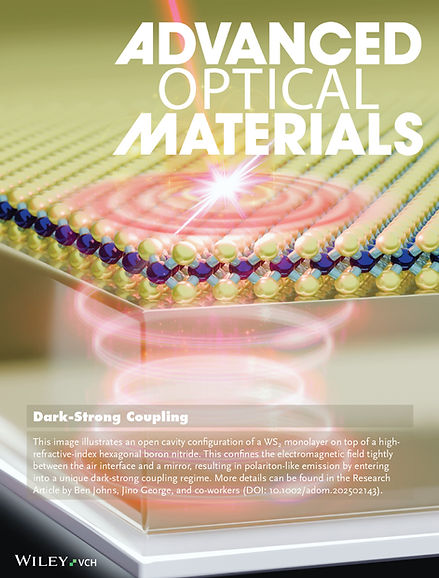
Johns B, Yadav N, Vinod A, Kaur K, George J. Understanding the Nature of Polariton-Like Emission in 2D Materials Coupled to Open Optical Cavities. Adv Opt Mater.2025, e02143. (https://doi.org/10.1002/adom.202502143)
Yadav N, Johns B, Banerjee K, Kaur K, Dutta J, George J. Vacuum Engineering of Light–Matter Interaction in Open Optical Cavities. ACS Applied Optical Materials. 2025. (https://doi.org/10.1021/acsaom.5c00330)
Garg P, Singh J, Gaur AK, Venkataramani S, Schäfer C, George J. Unveiling the role of dark states in dynamic control of azopyrrole photoisomerization by light-matter interaction. Communications Chemistry (Nature portfolio). 2025, 8(1):192. (https://doi.org/10.1038/s42004-025-01588-x)
Singh, J.; Garg, P.; Vijaya Anand, R.; George J., Cavity Catalysis of an Enantioselective Reaction under Vibrational Strong Coupling. Chemistry – A European Journal 2024, e202400607.(https://doi.org/10.1002/chem.202400607)
Dutta J, Yadav N, Bhatt P, Kaur K, Gómez D. E., George J. Enhanced Energy Transfer in Cavity QED Based Phototransistors. The Journal of Physical Chemistry Letters. 2024, 8211-7. (https://doi.org/10.1021/acs.jpclett.4c01511)
bottom of page